The Unlikely Origins of the Talking Cure
In the 1880s, Sigmund Freud traveled to Paris to train under Jean-Martin Charcot, one of the most influential neurologists of the nineteenth century. Charcot was so dominant in his field that he was sometimes called the “Napoleon of neuroses,” a title given to him for his commanding authority over the diagnosis and classification of neurological illness in Europe. Charcot had become known for his work with patients who presented with paralysis, amnesia, and loss of bodily sensation that had no identifiable physical cause, what was then being called hysteria. These symptoms puzzled the medical community because they did not follow any recognizable model of disease. There were no clear answers for what was causing these ailments.
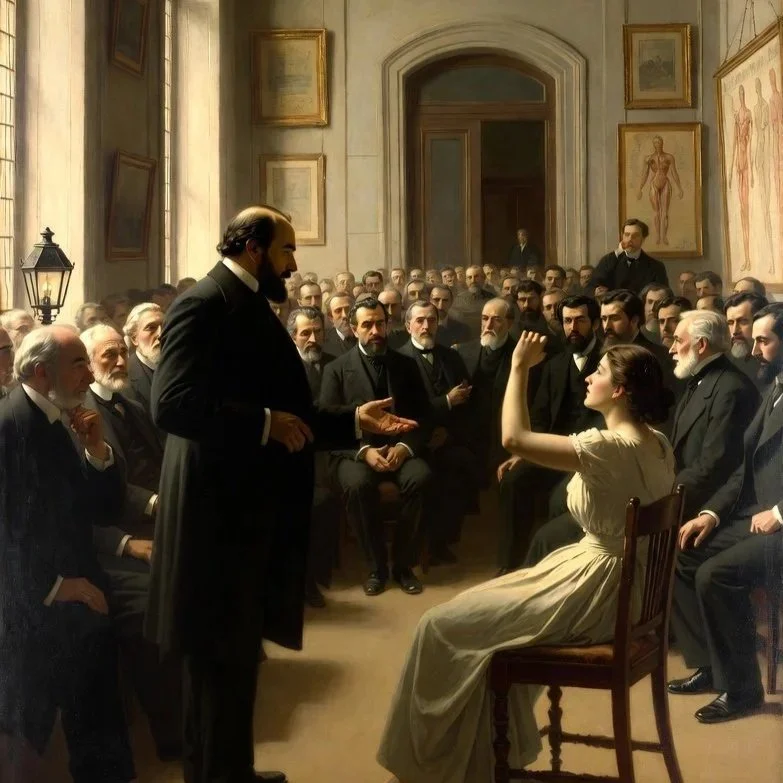
Charcot eventually turned to hypnosis as a way of investigating these symptoms, a method that at the time was widely dismissed as pure charlatanism. But in his public lectures on hysteria, he could place subjects in a trance and induce, then remove, these symptoms for which there were no identifiable causes. In other words, a patient who had lost movement in her arm could, under hypnotic suggestion, temporarily regain the ability to lift it. When the suggestion was reversed, the paralysis was “given back” to the patient. Charcot could also induce paralysis in healthy subjects and remove it just as easily. Why it worked was unknown, but the implication seemed clear. The mind seemed capable of switching real physical symptoms on and off outside of conscious control.
What Freud witnessed in those lectures had a lasting influence on him.
In letters to his fiancée, Freud wrote that Charcot had “completely absorbed” him and that what he had seen had overturned many of his assumptions about disorders of the body. He left Paris with a new sense of possibility, drawn to hypnosis as a way of approaching problems that had long resisted medical explanation.
Back in Vienna, Freud used hypnosis with patients but quickly ran into limitations. He found that not everyone could be hypnotized, and, by his own account, he had not developed much facility with it. More importantly, the method depended on creating a special state in the patient to access something he suspected might not require hypnosis at all. Freud began to consider a different possibility: that the material they were trying to reach was already present in the mind, and that the task was not to induce it, but to create the right conditions under which it could reveal itself.
This led Freud to ask patients to speak freely, saying whatever came to mind without inhibition. Thoughts that seemed irrelevant, embarrassing, or trivial were invited into the consultation room rather than filtered out. The idea was that everything was up for consideration and should be brought to the surface, since what seemed incidental might still be meaningful.
Talking, as the method of reaching unconscious material, would become the foundation of what would later be called the talking cure.
Freud continued refining the idea that psychological symptoms often arose when feelings, memories, or conflicts were pushed out of awareness because they were too painful or threatening to hold in mind. He eventually called this repression. Freud believed repressed material did not disappear. It remained active beneath the surface and showed up indirectly, often as symptoms.
A New Way of Understanding Symptoms
Before Freud, physicians generally assumed that physical symptoms of unknown origin had a medical cause that simply had not yet been identified. Freud proposed something different. He argued that the mind itself could be the source of suffering, and that treating it, rather than the body, was key to resolving the problem. When he first presented these ideas in Vienna to medical colleagues and within the broader psychiatric community, they were met with skepticism and even ridicule.
Freud’s central claim was that symptoms carry meaning and reflect something unresolved in the patient. Bringing what had been pushed out of awareness back into consciousness, he believed, could be therapeutic.
This marked the beginning of psychoanalysis, the root from which psychotherapy as a broader field would grow, grounded in psychological understanding rather than biological explanation. The field has expanded in many directions since Freud first introduced these ideas, but most approaches still share the core idea that a significant part of mental life operates outside conscious awareness. This hidden layer influences how we feel, how we relate to others, and why we sometimes act in ways we do not fully understand.
What Modern Psychodynamic Therapy Actually Looks Like
The image many people still have of psychodynamic therapy, of a patient lying on a couch while an analyst sits behind them quietly taking notes, is not entirely inaccurate. But this reflects an earlier stage of the field rather than how it is usually practiced today. Freud used the couch in part because it reduced the sense of being observed, which he found exhausting, and because it allowed patients to speak more freely without the temptation to edit what they were saying based on the therapist’s reactions.
The therapist’s role has also shifted. Traditional psychoanalysis was built on the idea of the analyst as an anonymous, detached, blank screen, and that conception has evolved considerably in modern practice. The therapist is now recognized as an inevitable presence in the room, shaping the process simply by being there. How the therapist brings themselves to the relationship, for example, how they respond to client lateness, payment issues, or silence, is now understood to affect the patient and is considered part of the therapeutic process. These moments can be used as opportunities to explore how the patient relates to others more broadly, not distractions from the therapeutic work.
What connects modern psychodynamic work back to Freud is a central insight, that people are not fully transparent to themselves and that much of emotional life operates outside conscious awareness. The therapeutic methods have evolved, but that recognition remains. Therapy has not moved away from Freud so much as extended the reach of what he first made visible.
What remains uncertain still is how much of us is ever fully visible to ourselves at all.
If you’ve ever considered therapy and found yourself wondering how talking could actually lead to change, hopefully this gives you a clearer sense of what the process is and why it works the way it does. I offer in-person therapy in downtown Jersey City and virtually throughout New Jersey. If you’d like to explore working together, feel free to get in touch.